Friday, November 24, 2023

Hey News Media. Trump’s Been Quoting Hitler All Along

To hear the news media, Donald Trump—the twice impeached, four-time criminally indicted former United States president—crossed some imaginary line when, in a Veterans’ Day speech this year, he called those he considered his enemies “vermin.” This, the pundits are saying, is an insult too far, verbiage akin to the hateful rhetoric of Nazi Germany’s Adolf Hitler.

What the press doesn’t seem to understand is Trump has been mimicking Hitler’s rhetoric from the minute he rode down his golden escalator with his trollop of a wife at his side to announce his run for the presidency back in June 2015.

Trump’s campaign slogan, Make America Great Again, came straight from Hitler’s mouth—literally—when the Nazi leader promised he would “make Germany great again.” And Trump’s promise to put “America First,” comes from the pro-Nazi “America First” movement of the late-1930s and early-1940s orchestrated chiefly by Nazi propagandist and secret agent George Sylvester Viereck, who also co-opted some two dozen conservative members of Congress into becoming unwitting agents-of-influence for the Germans.

Losers” and “Suckers”

In his Veterans’ Day speech, the six-deferment Vietnam War draft dodger—who considers everyone who served in the military “losers” and “suckers”—called those he perceived as his enemies—Democrats, the media, and the FBI—as “vermin” who posed a greater threat to the United States than the authoritarian regimes like Russia, China or North Korea that he so admirers.  "We pledge to you that we will root out the communists, Marxists, fascists and the radical left thugs that live like vermin within the confines of our country that lie and steal and cheat on elections,” he vowed.


Such words, the media shrieked, echo the hateful rhetoric of the Fuhrer, who often referred to Jews, homosexuals, Slavs, gypsies and many others as “vermin” who needed to be eradicated. But it wasn’t the first time he mimicked Hitler. In his announcement speech in Trump Tower, Trump promised to build a great wall to keep out immigrants from Mexico who, in his words, were “animals … bringing drugs, bringing crime, bringing rapists.”

In a May 2018 White House roundtable discussion, Trump said of immigrants: “These aren’t people. These are animals.” The following month he equated migrants and refugees coming to the U.S. with vermin who would “pour into and infest our country.” In a video interview this October, Trump said immigrants were “poisoning the blood of our country.”

In his book, Mien Kampf, Hitler described Jews—his favorite target of hate—as “bacillus,” “bloodsuckers,” “parasites,” and “vampires.” He considered Slavs such as Poles and Russians as “subhumans,” “barbarians,” and “vermin” needing extermination. He also decried the “blood poisoning” of the German people by the mixing of races and wrote how “the influx of foreign blood” was “the poison which has invaded the national body,” leading to the decline of Germany.

The Lying Press

Immigration isn’t the only topic Trump has turned Hitler’s vindictive against. Trump has used the tyrant’s words as his own when describing the news media. Hitler often referred to the press as the Lügenpresse, which is German for “lying press,” and accused it of being controlled by “Jews and Communists.”

Both during his Veterans Day rant and before, Trump called the American media “the lying press” and, in his November 11 speech accused them of being controlled by “Jews and communists.” Prior to this, Trump had his own way of paraphrasing Hitler’s attitude to the press, referring to them as “fake news” more than two thousand times during his presidency.

Hitler held democracy in contempt, blaming Germany’s parliamentary government for many of the nation’s ills and equating it with internationalism, weakness, and corruption. He also opposed the democratic principles of human rights, equality, and freedom of speech and press.

While Hitler never used Trump’s favorite term “Deep State”—the idea there is a hidden network of powerful and influential individuals and groups within the government­—the Fuhrer did express accusations about the existence of a hidden enemy within Germany and the world that was working against his interests and goals.

Since he entered the White House, Trump too has waged a war against democracy. He repeatedly questions the legitimacy of democratic institutions such as the free press, the judiciary, and the bureaucracy (i.e., the “Deep State”), the validity of elections, and the legitimacy of democratic contests. He has repeatedly exclaimed his admiration for dictators like Russia’s Vladimir Putin and North Korean’s Kim Jong Un and their authoritarian regimes, while deriding democratically elected leaders in the U.S. and Europe as weak.

The Big Lie

Finally, Trump’s attempt to overthrow the results of the last presidential election­—first by trying to co-opt members of the House and state legislators, then by stirring up the January 6 insurrection, and by repeating the “Big Lie” that he actually won that election—are all straight out of the Nazi playbook for overthrowing democracies. In May 2021, Trump said “the Fraudulent Presidential Election of 2020 will be, from this day forth, known as THE BIG LIE!” adding that “anyone who doesn’t say that the 2020 Presidential Election was rigged and stolen is either uninformed, naïve, or very stupid.”

Some 50 court cases—many presided over by Trump-appointed judges—ruled the 2020 election was fair and that Trump lost. Still, to this day he repeats this lie, again following Hitler’s rule book.

It was, after all, Hitler who first dreamed up the concept of the “Big Lie.” Hitler said “it is not truth that matters, but victory,” adding “by means of shrewd lies, unremittingly repeated, it is possible to make people believe that heaven is hell and hell heaven. The greater the lie, the more readily it will be believed.”

I was a hard news journalist for more than 20 years. I understand the need for the media to remain balanced and not toss accusations around wily-nilly. But there is a time when you need to take the duck test: "If it looks like a duck, swims like a duck, and quacks like a duck, then it probably is a duck.” If the man thinks like a Nazi, talks like a Nazi, and goosesteps like a Nazi, he’s probably a Nazi.

Saturday, November 27, 2021

Anti-vaxxers and the GOP Steal a Page from Hitler's Playbook

The most prevalent rhetoric of the Covid anti-vaxxers is that government requirement vaccine mandates are fascist. In fact, allusions to Adolf Hitler, the Nazis, and the Holocaust are rampant in their rhetoric. What these protestors don’t understand is that the GOP’s extremists like Greg Abbott in Texas and Ron DeSantis in Florida, as well as the screwball crew at Fox News, are taking a page straight out Hitler’s playbook.

How?

Because the Nazis were anti-vaxxers, too.

Before the Little Corporal became Der Fuhrer, Germany had a long history of compulsory vaccination. In 1847, after a smallpox epidemic killed tens of thousands of Germans in Prussia, the government ordered all newborns and military recruits vaccinated against the scourge as well as other diseases.

The German vaccination programs were quite successful. But in the waning years of the democratic Weimar Republic, an antivaccination movement took root. Called the Lebensreform, or Life Reform Movement, it advocated replacing vaccines with healthier lifestyles such as getting more sun and eating special diets.

The Life Reform Movement was also anti-Semitic. According to its adherents, vaccines were part of a global Jewish conspiracy to harm the German people. This isn’t too far from today’s antivaxxers who claim the Covid vaccines are unsafe (instead, they advocate taking a horse dewormer or drinking bleach) or that the vaccines inject tracking devices into our bodies (while they all carry cell phones by which they actually can be tracked).

Fearing protests, the Weimar government loosened its vaccine policies. When the Nazis came to power in the 1930s, they did not issue mandates for vaccination and what mandates were still in effect were largely ignored. In fact, like today’s GOP, they went out of their way to appease the Life Reformers. In 1935, Hitler’s Reich interior minister, Wilhelm Frick, said, “the popular character of the health laws, which must appear to be absolutely desirable in the National Socialist state, is better served if unnecessary restlessness is avoided in the implementation of the laws in the population.”

In other words, don’t rock the boat. German vaccination requirements under the Nazis became voluntary.

The Nazis’ nonchalance toward vaccination wasn’t just politically convenient. It had a more sinister side. Hitler and his cronies knew that the Germans they considered less desirable—Jews, gypsies, the mentally and physically handicapped—were also less likely to get vaccinated and, therefore, more likely to die. As the black shadow of Nazism spread across Europe and Russia, the party’s antivaccine policies became an even bigger genocidal weapon.

 According to Hitler’s Table Talk, a compilation of Der Fuhrer’s droning monologues, this was the Nazi leader’s ideas on vaccines and public health in the occupied countries: “Their conditions of life will inevitably improve under our jurisdiction, and we must take all the measures necessary to ensure that the non-German population does not increase at an excessive rate. In these circumstances, it would be sheer folly to place at their disposal a health service such as we know it in Germany; and so—no inoculations and other preventative measures for the Natives! We must even try to stifle any desire for such things by persuading them that vaccination and the like are really most dangerous!” (Emphasis added.)

Is this so different from the sentiments of the far-right extremists of the GOP or the anti-vax “reporting” of Fox News? They know the Covid vaccines aren’t dangerous. Most of them­—hell, probably all of them—are vaccinated. We know the talking head yo-yos at Fox News are vaccinated—it’s a company mandate. They also know Covid is dangerous; at this writing, at least seven anti-vax and anti-mask conservative activists have died from Covid and its complications.

So why all the antivaccination rhetoric?

Could the GOP extremists be taking a page out of the Nazis’ antivaccine playbook? They know Covid deaths are highest among those they don’t consider desirable voters—the poor, people of color, the elderly—people who don’t normally vote Republican. Have the Republicans become so power hungry they are willing to sacrifice their own voters—who are, in fact, dying in droves from Covid—in order to “cleanse” the nation of those they don’t want to cast votes by trying to, in Hitler’s own words, “to stifle any desire for such things by persuading them that vaccination and the like are really most dangerous!”?

Just asking.

Tuesday, August 31, 2021

Escape from the Graveyard of Empires

Watching the hurried evacuation of American citizens, troops, and Afghani allies from the Kabul airport in August might seem to be an embarrassing defeat for the U.S. and the Biden administration. However, considering that the “former guy” had nearly a year to begin the withdrawal and did little, America’s exit from Afghanistan is nearly as remarkable as WWII’s Miracle at Dunkirk.

It’s all the more remarkable considering the long saga of failed ventures to occupy Afghanistan by some of the most powerful empires in history, from the Persians to the Mongols. After initial successes, these empires ultimately met with failure if not outright defeat. Even Alexander the Great’s unmatched record of conquering countries met its end in this country that is often called The Graveyard of Empires.

What we today call Afghanistan was Alexander the Great’s last stop on his rampage to conquer much of the known world. After defeating the Persians in Afghanistan, Alexander tried to push on to what is now called Pakistan (then the northern portion of India). Alexander left a good portion of his army lying dead in the Kindu Kush mountains. While trying to tame Afghanistan, Alexander began a physical and mental deterioration that led to a rebellion among his forces, forcing him to pull back to Babylon. He died not long after.

Britain's First Retreat

Britain fought two wars in Afghanistan in the 1800s; both failed to gain control over the region. (A Third Anglo-Afghan War was fought in 1919, but most of the fighting took place in neighboring India.) The First Anglo-Afghan War led to one of Britain’s worst military defeats.
Remnants of an Army by Elizabeth Butler shows the only British solider to
survive Britain's 1842 retreat from Kabul.

After occupying Kabul for three years, British forces were forced to evacuate the city in 1842. More than 16,000 troops and camp followers marched out of Kabul and into the Khyber Pass, a mountainous route through the Kindu Kush that links Afghanistan and Pakistan. Like Alexander before them, the British littered the mountain range with the bodies of their people. Out of the 16,000 troops and camp followers, only one British officer made it out the other end of the pass.

The Soviet Union invaded Afghanistan in 1979 intending to prop up a pro-Russian government in Kabul. The ten-year Soviet-Afghan War was not only unpopular in the USSR (it was referred to as Russia’s Vietnam), it was also extremely costly in both blood and national treasure. When Soviet leadership was taken over by moderates like Mikhail Gorbachev, the decision was made pull their troops out.

The End of the USSR

The Soviet pull-out was not as disorderly as Britain’s 1842 withdrawal. The USSR allowed itself nearly a year to slowly evacuate Afghanistan, beginning the withdrawal in May 1988 and completing it in February 1989. While orderly, it wasn’t without problems. At one point, Soviet troops had to fight their way past a recalcitrant Afghan warlord and his fighters.

While the Soviet withdrawal was ultimately successful, the die was cast for the fate of the USSR. In December 1991, the Soviet Union ceased to exist.

In nearly each case, the cause of the occupation’s failure lay in the fact that Afghanistan was never really a country to begin with. The region has always been a hodgepodge of tribal factions led by warlords who form and destroy alliances based on who they saw as common enemies. There was no sense of nationality or common interest. Even when the Taliban “ruled” Afghanistan in the aftermath of the Soviet withdrawal, they still had to deal with dozens of individual warlords who refused to bend fully to their reign.

Trump's Failure

Donald Trump signed a withdrawal agreement with the Taliban in February 2020 after months of “negotiation” in which he handed them everything they asked for. There can be no doubt Trump’s military advisors, pointing to the Soviet example, told him the withdrawal would take as long as a year to accomplish properly. While troops began withdrawing in mid-2020, Trump never ordered the evacuation of nonessential personnel like the families of embassy staff, contractors, and Afghani allies, which should have been the first step.

In fact, Trump policies that made it harder to organize the evacuations. For instance, his immigration policies made it nearly impossible to issue Special Immigrant Visas (SIV) to Afghani who worked for the U.S. and NATO during our 20-year war there, leaving a backlog of more than 17,000 SIV applications when President Joe Biden took over. In fact, Trump refused to even brief Biden and his transition team on the situation in Afghanistan, leaving the new president in the blind until he took office.

That Trump did little to accomplish the withdrawal from Afghanistan for nearly a year—despite the fact he said he want to be out of the country by May of this year—forced Biden into a quick and hasty withdrawal process. The massive C-17 air transports flying out of Kabul this August did not carry military personnel, they carried those people who should have left Afghanistan last year.

Considering how little had been done by Donald Trump after signing the withdrawal agreement, what we watched happening at the Kabul airport was nothing less than a miracle in military logistics and a sign that for the first time in four years, we have real leadership in the White House.

Tuesday, May 25, 2021

The American Putsch: The First GOP Coup the Republicans Tried to Whitewash

According to Republicans in Congress, the violent Jan. 6 attack on the national Capitol was little more than a friendly tour of congressional offices by patriotic Americans. On May 12, Rep. Andrew S. Clyde, a Republican from Georgia, downplayed the insurrection as a “normal tourist visit,” despite photographs taken during the attacks showing the retired Navy officer panicking as insurgents tried to bash their way into the House chamber.

Wisconsin Sen. Ron Johnson claimed it was a “false narrative” to say, “there were thousands of armed insurrectionists breaching the Capitol.” This despite the fact four people died because of the riot, including a Capitol police officer who was beaten and spayed with dangerous chemicals, and that dozens of Capitol and municipal police officers suffered severe injuries, including losing fingers and, in one case, an eye. Johnson’s remark also ignores the fact the rioters were armed with firearms, stun guns, bear spray, even a gallows with a hangman’s noose as they chanted “Hang Mike Pence.”

Some congressional Republicans are trying to deflect blame for the assault away from Donald Trump, who incited his extremist MAGA supporters to riot with his “big lie” rhetoric that the November 2020 election was stolen from him. To them, the Trump supporters were peacefully protesting while outside agitators from Black Lives Matters or Antifa were the actual attackers. (To set the record straight, the FBI said the rioters were all Trump supporters, some 400 of which are currently facing assorted federal misdemeanor and felony charges.)

Yet other Republicans are saying the country needs to move forward and leave the past behind. These, of course, are the same GOPers who continue to promote Trump’s big lie about the election.

GOP Opposes Investigation

On May 19, all but 35 of House Republicans voted against a bill establishing a bipartisan committee to investigate who was behind the insurrection. The bill passed, but still faces strong Republican opposition.

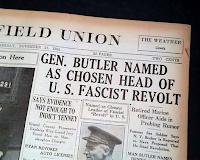
As unbelievable as this conduct appears to any truly patriotic American, it’s not unexpected. It isn’t the first time Republicans tried to whitewash an attempted coup by their cohorts. They did the same thing 88 years ago in the aftermath of the Republican-backed American Putsch.

Also referred to as the Banker’s Revolt and the Wall Street Plot, the aborted putsch took place shortly after President Franklin D. Roosevelt took office. The plot involved raising a small army to storm the White House, arrest FDR, and establish a fascist dictatorship. And, despite the GOP's attempt to portray the plot as imaginative thinking, it was in fact a well-organized and well-financed attempt to overthrow the U.S. government that involved top members of the party.

Legendary American Hero

Retired Marine Corps Maj. Gen. Smedley
revealed a 1933 fascist plot that the GOP
tried to whitewash.

Retired Marine Corps Major General Smedley Butler was a legendary American hero. A recipient of two Medal of Honors for combat actions in America's Banana Wars of the early 1900s, he was also lauded for siding with WWI veterans when they were attacked by the Hoover administration during the Great Depression-era Bonus March.

In 1933, Butler was approached by Gerald P. MacGuire, a Wall Street broker, and another man representing wealthy and conservative American bankers and industrialists. The men explained they had been sent to Europe to study fascism and how best to bring it to the United States. Their backers decided a coup was the best idea. They intended to raise an army of disgruntled WWI veterans to attack the White House, dispose FDR, and install a fascist government—and they wanted Butler to lead it.

Butler was no fool. Despite being a legend in the Marine Corps, “Old Gimlet Eye” as he was called was a progressive iconoclast with a reputation for butting heads with the big brass. Butler didn’t dismiss McGuire’s plot, but played along and gathered evidence for the FBI which eventually exposed the conspiracy.

Dismissed by Republicans

Butler’s evidence was immediately dismissed as a hoax by the Republicans and conservative newspapers. Nevertheless, Democrats initiated a congressional investigation by the House Un-American Activities Committee (HUAC). Hampered by recalcitrant Republicans, the HUAC investigation, at best, was proforma, with only Butler and MacGuire called as witnesses and the involvement of several prominent, politically powerful financiers and businessmen ignored.

Nevertheless, HUAC report concluded, "In the last few weeks of the committee's official life it received evidence showing that certain persons had made an attempt to establish a fascist organization in this country. No evidence was presented, and this committee had none to show a connection between this effort and any fascist activity of any European country. There is no question that these attempts were discussed, were planned, and might have been placed in execution when and if the financial backers deemed it expedient."

In other words, the planned coup was entirely the work of wealthy Americans with no help from fascist governments in Europe.

No one was ever charged in the coup attempt, largely because FDR suppressed the most damning evidence fearing it would cause a public uprising. The Republicans continued to whitewash the plot, dismissing it as a ruse even to this day. Transcripts of the HUAC testimony was finally made public in 1967. The BBC added more substance to the coup story, reporting in 2017 that one plotter was none other than Wall Street investor Prescott Bush, future U.S. senator, and father and grandfather of two American presidents. Bush was a well-known supporter of Hitler's rise to power and was prosecuted for continuing to do business with the Nazis even after Hitler declared war on the United States in 1941.

Unparalleled Parallels

The parallels between the American Putsch and the Jan. 6 Insurrection are obvious: Trump’s incitement of the riot to overthrow the election of President Joe Biden, and Prescott Bush’s and his cronies’ attempt to incite a rebellion to overthrow the election of FDR. Only the Trump Putsch was put into motion, and it was violent. Unlike the American Putsch, Congress doesn’t need to rely on the testimony of two individuals. There are hundreds of hours of video taken by the news media and security cameras. Dozens of police officers have described the viciousness of the attack. Most important, there is video of Trump and several congressional Republicans inciting the seditionists, and evidence some of those members of Congress may have taken part in its planning. In fact, some of the House Republicans who voted against the House investigation are expected to be called as witnesses. Of course, they want to limit their culpability by downplaying the seriousness and violence of the revolt.

All this raises a question too few are willing ask: Should a political party whose members were involved in two coup attempts to overthrow American democracy be allowed to continue?


More reading on the American Putsch:

 Gerald MacGuire and the Plot to Overthrow Franklin Roosevelt

The Wall Street Putsch: Did Fascist Bankers try to Overthrow Franklin Roosevelt?


Tuesday, March 23, 2021

Hong Kong, Voter Suppression, and Republican Hypocrisy

The Republican Party is taking a firm stance against China’s anti-democratic policies designed to thwart free elections and autonomy in Hong Kong. The Beijing government is foisting new election laws on the former British colony intended to end the “one country, two systems” policies that allowed Hong Kong to exist as a democratic enclave in an otherwise totalitarian state.

Last year, GOP Senate Minority Leader Mitch McConnell praised Hong Kong’s pro-democracy, “demonstrations against the repressive grip of the Chinese communist party.” And he hailed the fact that “Hong Kong voters with American flags in hand dealt crushing defeats to Beijing’s preferred puppet candidates in elections last fall.”

McConnell continued his support for Hong Kong democracy this year by criticizing new Chinese laws restricting voters’ rights in the enclave. “The Chinese Communist Party is trying yet again to tighten their grip,” he said. “New laws supposedly related to national security aim to stifle dissent and curtail Hong Kongers’ civil liberties.”

Sen. Ted “Cancun” Cruz, R-Texas, also supported Hong Kong’s civil rights movement, saying last


January, “I’ll continue to support and stand alongside those of you speaking out against tyranny and fighting for freedom.”

China’s authoritarian government and its attempts to destroy democracy in Hong Kong deserve the strongest condemnation. Yet the GOP’s response to the Chinese restrictions would be more admirable if it weren’t so hypocritical.

At the same time McConnell criticized China’s new laws curtailing the civil liberties of Hong Kong’s citizens, the Republican Party was launching a multitude of state-level voter suppression laws to prevent American citizens of color from casting votes in future elections. And, as in Hong Kong, the reason for passing these anti-democracy laws was that the GOP suffered crushing election defeats in November 2020.

In February, the Brenner Center for Justice reported that “33 states have introduced, prefiled, or carried over 165 restrictive bills this year.” In the first two months of 2021, Republican state legislatures introduce four times the number of voter suppression bills than introduce in the whole of 2020. The Center described this anti-democracy legislation as “a backlash to historic voter turnout in the 2020 general election and grounded in a rash of baseless and racist allegations of voter fraud and election irregularities.”

Salon reported that number to be much higher, claiming the “tidal wave of (Republican) voter suppression” included 253 bills in 43 states.

These bills aim to limit mail-in voting, which became popular in 2020 during the COVID crisis; impose stricter voter ID requirements, which makes voting difficult for the elderly and minority voters who don’t drive; slash voter registration opportunities, also aimed at the elderly and people of color; and enable more aggressive voter roll purges, all aimed at removing people of color from the voting rolls.

Georgia—where a massive voter turnout helped give Joe Biden the presidency and sent two Democrats to the U.S. Senate—is one of the states scrambling to make it harder for its citizens to vote. On March 26, the state's governor, Brian Kemp, signed into law a bill that bans automatic voter registration, limits Sunday early voting days and ballot drop boxes, and restricts absentee voting. It also prohibits volunteers from passing out free food and drinks to people forced to stand in lines for hours because of the state's failure to provide adequate polling places in minority neighborhoods.

Georgia’s Republican legislators introduced the bills in response to Donald Trump’s baseless claim of widespread voter fraud in the state.

The Georgia restrictions are so heinous and so obviously aimed at Black voters they are being compared to the Jim Crow laws which existed in the U.S. from the end of the Civil War until 1968. “We know their targets are Black voters,” said Cliff Albright, co-founder of the Atlanta-based Black Voters Matter. "These (legislation) notes are dripping in the blood of Jim Crow.”

Jim Crow laws were state and local laws that marginalized African Americans by denying them the right to vote, hold jobs, get an education, or marry outside their race. Violating Jim Crow laws often faced arrest, fines, jail sentences, violence, and death.

Lest there be any doubt as to the oppressive nature of the Jim Crow laws, they were so admired by Nazi dictator Adolf Hitler he used them as a model for the German racial purity laws that restricted the rights of Jews, Blacks, Slavs, and Roma.

The Republican Party did not suffered setbacks in November 2020 because of voter fraud. Repeated investigations by federal and state agencies declared the election one of the cleanest in U.S. history. Fifty lawsuits filed by Trump supporters alleging voting fraud were found without merit by state and federal courts. The Republicans lost because their presidential candidate was widely unpopular because of his hateful rhetoric, unprecedented corruption, and dictatorial ambitions.

Both the Chinese government and the Grand Old Party need to realize governments only suppress the vote because their policies are unpopular. If you want to win over voters and win elections, don’t restrict people’s right to vote, change your policies.

Tuesday, November 17, 2020

That Time When Business Greed Nearly Lost the Allies WWII and How It Relates to the Covid Crisis

We are plunging toward a dark and dangerous winter. A third wave of Covid-19 infections is surging around the world. At this writing, U.S. Covid cases are increasing at a rate of more than 100,000 new infections per day. One thousand Americans are dying from the virus each day. The health care facilities of nearly every state are being overwhelmed by Covid caseloads.

It is a sad fact that all this could have been avoided.

If more state governments had been responsible and closed the bars, restaurants, gyms, and political rallies that act like petri dishes for the virus’s growth, Covid’s impact could have been mitigated. But too many politicians bent to the pressure placed on them by both small businesses and corporations to avoid such lockdowns. Even in states like California, where a lockdown did start to contain the virus, politicians eventually caved and lifted restrictions too early and too quickly.

We’ve seen this same profit-at-any-price mentality in this country before when another scourge threatened American lives, and businesses refused to adapt to the situation to save lives. The last time we saw this kind of thinking, we nearly lost WWII.

Operation Drumbeat

Within weeks of declaring war on the United States, Adolf Hitler launched a U-boat offensive against the American East Coast called Operation Paukenschlag (Operation Drumbeat). On January 14, 1942, the first German sub arrived off the coast of Rhode Island, soon followed by four more. The German sailors were delighted to find tankers and freighters sailing alone without escort. Even more surprising, they found the coast brightly lit by shore lights that provided U-boats with perfectly silhouetted targets.

Blackouts are a necessity of war. Across the Atlantic, blackouts were imposed on every English, French, and German shoreline. Even before entering the war, American military officials realized the potential need for blacking out the Eastern seaboard at night. But local chambers of commerce, fearing a loss of profits, fought every attempt to impose a coastal blackout.

The result was devastating.

In just weeks, those first five U-boats sank 16 ships totaling 104,761 tons. Allied logistics experts estimated the loss in ships, cannon, vehicles, and fuel was equivalent to the damage caused by 30,000 German aerial bombing sorties. And it was just the beginning.

Like the coronavirus, the U-boat onslaught came in waves. The first wave may have come as a surprise—though it shouldn’t have—but there was no excuse to not be prepared for the following waves. But, just as with the Covid crisis today, America remained unresponsive to the threat

The blame can’t be laid entirely at the feet of East Coast business interests—though they fought tooth-and-against blacking out shoreline enterprises. Just as with the Covid crisis, there was ineptitude at high levels of government where bureaucrats would not accept the reality of a U-boat threat in American waters.

The Anglophobe Admiral

Admiral Ernest King, chief of naval operations, was an Anglophobe. A British official described King as “intolerant and suspicious of all things British, especially the Royal Navy.” Before America entered the war, King rejected all calls for preparing for a U-boat attack on the United States, refusing to believe Germany had such a capability despite the fact U-boats had operated in American waters in WWI.

Merchant ship Dixie Arrow torpedoed off Cape Hatteras by U-71, 26 March 1942.

Like Donald Trump’s refusal to accept the reality of the Covid crisis, King refused to acknowledge the threat facing merchant ships sailing in American waters or his own failure to protect them. Even after the first German submarine onslaught, King’s Anglophobia made him resist implementing any of the hard-won lessons the English learned about fighting U-boats in three years of war. He adamantly refused to adopt a convoy system to protect Allied shipping as the British had despite the fact that convoys—groups of merchant ships protected by sub-hunting ships and patrol boats—was used by the American Navy in WWI. King’s attitude, and that of many of his subordinates, was summed up by U.S. Rear Adm. R. S. Edwards. “Americans must learn by their own mistakes,” he told a British colleague, “and we have plenty of ships.”

In fact, we did not have plenty of ships.

By mid-March, the loss of oil tankers was so great that the Petroleum Industry War Council warned the U.S. would run out of oil in six months. By June 1942, Army Chief of Staff George C. Marshall worried “that another month or two of this . . . [and] . . . we will be unable to bring sufficient men and planes to bear against the enemy . . .”

The danger to the war effort posed by King's ethnocentrism prompted General Dwight D. Eisenhower to write, “One thing that might help win this war is to shoot King.”

To the British, the Battle of the Western Atlantic was a “holocaust.”

A convoy system wouldn’t be organized until mid-1942, when President Franklin D. Roosevelt ordered King to implement one.

And still the lights shone

In February 1942, FDR issued an executive order giving the military authority to order coastal blackouts. Once again, seashore businesses pushed back, and the military hesitated to implement the order. Admiral King sent the coastal defense commander a “request” to implement a “dimout” of shore lights, but he still refused to call for a full blackout.

U-boats victories mounted as did merchant ship losses. For the tourists and party clubbers enjoying the well-lit coastal nightlife, the war came home the hard way. At night, they could see torpedoed ships burning offshore. In the mornings, those same fun lovers found the scorched bodies of merchant sailors that had washed ashore. Eventually, coastline businesses began to lose money simply because people did not want to be that close to the reality of war. And still, they refused to execute blackouts until much later in the year.

By then the damage was done. In the first six months of 1942, nearly 400 Allied merchantmen were sunk in American waters at a cost to Germany of only six U-boats. Unlike Pearl Harbor, none of the ships were salvageable. No one was ever held responsible for these terrible losses. It would still take until the first half of 1943 before American anti-submarine warfare capabilities caught up with those of Britain and Canada.

(New York Times)
Today Americans face a similar deadly threat, one that threatens the well-being of us all, not just a relative few merchant sailors. Yet we’re are seeing the same inaction and ineptitude that nearly lost us the war against the Axis Powers. While European countries are seeing positive results by reimposing restrictions on restaurants, bars, and other gathering places, too many Americans still resist taking basic precautions that can slow the spread of the virus and save hundreds of lives (see graph). At this writing, just shy of a quarter million Americans have died from the disease, and the number keeps climbing every day.

In his book Operation Drumbeat, author Michael Gannon concludes, “Civilian avarice and carelessness must take their places on the list of agents accountable for the U-boat triumphs.”  When the history of America’s war against Covid-19 is written, what will the historians say of us?

Friday, October 16, 2020

Militia Plots: A Rare but Serious Threat

The news shocked many Americans. The FBI announced they had thwarted an armed rightwing extremist militia plot to capture local government officials and hold them hostage.

You may think I’m talking about the October arrests of more than a dozen Michigan militia henchmen who were planning to abduct Democratic Gov. Gretchen Whitmer and put her on trial for the heinous crime of trying to save Michiganders from the coronavirus.

You’d be wrong if you did.

What I described above was a 1934 plot to seize control of the San Diego, CA city hall by a rightwing militia of quasi-Christian zealots called the Silver Shirts. Founded in 1933 by William Dudley Pelley (right), a one-time presidential candidate, the Silver Legion of America was patterned after the Italian dictator Benito Mussolini’s Black Shirts with the intention of establishing a “Christian Commonwealth” in America that would exclude all Jews and nonwhites.

The Silver Legion was a pro-fascist/Nazi group, one of several that existed in the U.S. in the 1930s. (See: American Fascists: A Forgotten History.) The local contingent of Silver Shirts concocted a plan to overthrow San Diego’s city government when they heard rumors that a group of communists was making similar plans (they weren’t). Two Marines from Camp Pendleton uncovered the plot when they infiltrated the Legion while investigating a series of weapons thefts from local military units.

Militia coup attempts like those thwarted in San Diego and Michigan might seem rare, but they aren’t unknown, and they are no laughing matter. They pose a very real threat to American citizens and to our democracy.

 The first antigovernment militia coup was the 1791 Whiskey Rebellion. Contrary to the belief of many radical gunowners that the Second Amendment was intended by our Founding Fathers to provide for the overthrow the government, the Whiskey Rebellion was quickly put down by a federal force led by then-President George Washington. (See: The Myths that Drive America’s Love of Guns.)

Anti-government militia plots have been the bane of American life, particularly since the 1990s. Several militia plots were uncovered during that decade. Members of a group called the North American Militia planned to bomb several targets in Michigan, including a federal building and an IRS building, and even discussed assassinating various government officials.

In 1997, members of a Missouri militia group planned a July 4 attack on Fort Hood, Texas, as the military base hosted an annual “Freedom Festival” attended by 50,000 men, women, and children. Fortunately, the FBI and the Missouri State Highway Patrol thwarted the plot. (See: The Militia Movement.) And in March 2011, the FBI charged nine members of an extremist militia group in Michigan with seditious conspiracy for plotting to attack law enforcement and spark an uprising against the government. (See: Domestic Terrorism: Focus on Militia Extremism.)

These rebellions were stopped or quickly suppressed before they started. But that doesn’t mean militia coups are not dangerous. In 1898, a white supremacist militia successfully overthrew the biracial city government of Wilmington, NC. There was no response to the deadly coup from local police, the state government, or Washington, DC. Its success is having unfortunate repercussions in today’s presidential politics, as Donald Trump keeps holding up that event as a model for future coups. (See:  The White Supremacist Coup that Trump Uses as a Template.)

Many Americans like to believe Timothy McVeigh’s April 19, 1995 bombing of the Oklahoma City federal building that killed 168 men, women, and children was the act of a “lone wolf” terrorist, Timothy McVeigh. In fact, in addition to McVeigh, three accomplices were also charged and tried for the crime. They had hoped the bombing would initiate an uprising that would take down the U.S. government. McVeigh was also a member of Christian Identity, a rightwing, white supremacist militia, which the FBI believed may have also been involved with the plot. (See: Were There More OKC Conspirators?: The Elohim City Connection.)

The last four years saw a rise in militia activity, thanks to the hateful and extremist rhetoric of Donald Trump. Armed militia members confronted peaceful Black Lives Matter protestors and marched to protest social distancing practices implemented by local governments in the wake of the coronavirus. Even before planning to abduct Gov. Whitmer, Michigan militia gunmen marched on the state capitol in an obvious threat to state lawmakers.

Not all rightwing coup plots were the work of militia movements. In 1933, a group of wealthy conservative bankers and financiers plotted to raise a private army and use it to overthrow the American government and establish a fascist dictatorship. Called The American Putsch and The Bankers Revolt, the plot was thwarted by the man they approached to lead their army. Smedley Butler, a retired Marine Corps major general and two-time recipient of the Medal of Honor, played along with the conspirators and collected evidence for the FBI. One of the alleged conspirators was a wealthy, pro-Nazi financier named Prescott Bush, father and grandfather of two U.S. presidents. (See: American Fascists: A Forgotten History.)

Unlike George Washington riding forth to preserve the country and democracy during the Whiskey Rebellion, Donald Trump has done nothing to mitigate the threat from these rightwing extremist groups. On the contrary, Trump appointed self-avowed pro-fascist, white nationalists like Steve Bannon and Stephen Miller to his staff. He’s referred to white nationalist groups as “some good people” and told the Proud Boys to “stand by.” Trump has also called for armed militia members to act as “poll watchers” during the balloting. His failure to condemn these hate groups or their malicious plots only encourages them to continue their terrorist plots. More conspiracies will be on the horizon as long as this irresponsible president remains in power.

And despite the best efforts of law enforcement, the next plot may not be stopped in time.

Sunday, October 11, 2020

Hitler and Trump: Two Men With a Single Mind?

 There is a new meme making the rounds on Twitter. It is a quote from a WWII psychological profile of Adolf Hitler commissioned by the Office of Strategic Services, forerunner of the CIA. The quote says, “His primary rules were: never allow the public to cool off; never admit a fault or wrong; never concede that there may be some good in your enemy; never leave room for alternatives; never accept blame; concentrate on one enemy at a time and blame him for everything that goes wrong; people will believe a big lie sooner than a little one; and if you repeat it frequently enough people will sooner or later believe it.”

Obviously, the quote has gone viral because many people believe it applies as easily to Donald Trump as it does to Der Fuhrer. But a close reading of the full OSS report, “A Psychological Analysis of Adolf Hitler: His Life and Legend,” reveals many more similarities between the Nazi dictator and America’s wannabe fuhrer—so many that one could believe they were one and the same man.

Family: Both Hitler and Trump had authoritarian fathers. Alois Hitler was described by Hitler’s British-born nephew, William Patrick Hitler, as a drunk and tyrant who regularly beat his children. Trump’s father, Fred, was also an authoritarian parent, demanding daily reports from his wife on the children’s conduct and dictating disciplinary actions. According to Trump’s niece, Mary L. Trump, Fred pushed his eldest son, Fred Jr., to become as ruthless as he was so he could take over the family business. Fred Jr., however, wanted to be an airline pilot. After that, Fred Sr. “dismantled [Fred Jr.] by devaluing and degrading every aspect of his personality." Mary Trump blames her grandfather’s treatment of her father for the alcoholism that eventually killed him.

In Awe of Authority: Despite his media persona as a man of strength and resolute courage, Hitler was humbled by persons of authority. “From the weight of evidence, it seems certain that Hitler does lose his self-confidence badly when he is brought face-to-face with an accepted authority of high standing…” Yet, he was in constant search for a male figure he could use as a guide. “[T]hroughout his later life we find him searching for a strong masculine figure whom he can respect and emulate.” Hitler was drawn to strong, authoritarian historical figures such as Caesar, Napoleon, and Frederick the Great. According to the OSS report, Hitler was confused by leaders such as President Franklin D. Roosevelt who could lead a country and “still act like a gentleman” without “a great deal of name-calling, shouting, abusing, and threatening.”

It’s well known Trump has never met a dictator he didn’t submit to. Vladimir Putin of Russia, Xi Jinping of China, Rodrigo Duterte of the Philippines, Recep Tayyip Erdogan of Turkey, Kim Jong Un of North Korea are all authoritarian leaders Trump has praised and, in most cases, provided with preferential treatment over his own country. (See: Nine Notorious Dictators, Nine Shout-Outs From Donald Trump). At home, Trump openly suggests he wants to wield such power and attempts to do so by threatening and abusing anyone who stands up to him.

Young—Very Young—Women: Throughout his political career, Hitler portrayed himself as a man alone whose only mistress was Germany. Trump, on the other hand, has extravagantly exaggerated his prowess as a playboy. Neither depiction is true. Hitler, like Trump, had a penchant for very young, even underage girls.

Hitler’s first tryst was with Henny Hoffman, the daughter of his official photographer. Hitler first met Henny when she was nine. Henny was about 17 when her mother died and she began dating Hitler. He was in his thirties. “The relationship continued for some time until Henny … got drunk one night and began to talk about her relationship with Hitler,” according to the OSS report.

Henny was followed by a mysterious relationship with Geli Raubal, the daughter of Hitler’s half-sister, Angela. Geli lived with Hitler, 19 years her senior, in his Munich apartment. According to the OSS profile, Hitler spent lavishly on Geli and was extremely jealous of any men who paid attention to his niece. The affair did not end well. In September 1931, Hitler traveled to Nuremburg for a party meeting. The next day, Geli was found dead in his apartment of a gunshot wound to the lung. Hitler’s personal pistol laid next to her. Despite suspicions otherwise, her death was ruled a suicide.

Eva Braun was only 17 when she first caught Hitler’s eye, 23 years younger than Der Fuhrer. Theirs was Hitler’s longest relationship with a woman though he tried to hide it from the German people. It, too, was tumultuous, with Braun twice unsuccessfully attempting suicide. They finally married days before the German surrender, then committed suicide inside the Fuhrer Bunker.

Two of Trump’s wives were much younger than he when they married. Marla Trump was 17 years younger than Trump, and Melania 24 years younger. Trump frequently partied with Jeffrey Epstein, a financier and convicted child molester who was charged with sex trafficking minors in 2019 shortly before he allegedly committed suicide in a jail cell. In 2016, a woman accused Trump in a Manhattan federal court of raping her at one of Epstein’s parties when she was only 14 years old. The alleged victim dropped her suit after receiving multiple death threats from Trump supporters.

Trump has repeatedly made lascivious comments about his own daughter, Ivanka. During a 2003 Howard Stern Show interview, he said Ivanka had “the best body.” On the television show The View, Trump said, “I’ve said if Ivanka weren’t my daughter, perhaps I’d be dating her." He also once allegedly asked a friend, “Is it wrong to be more sexually attracted to your own daughter than your wife?” Ivanka was 13 at the time.

Hitler and Trump may have shared another sexual aberration—golden showers. It has long been suspected that Russia’s Putin has video of Trump engaging in sexual urination with two prostitutes in a Moscow hotel. According to the OSS report, Hitler engaged in the same sex games. “His sexual pervasion has quite a different nature that few would have guessed,” it says. “… [A]n extreme form of masochism in which the individual derives sexual gratification from the act of having a woman urinate or defecate on him.”

Draining the Swamp and Other Christ-like Things: Donald Trump ran for office claiming only he could “drain the swamp” in Washington, DC. Hitler, too, came to power claiming he would drain the Berlin swamp. “When I came to Berlin … and looked at the traffic… the luxury, the perversion, the wanton display… disgusted me so thoroughly, that I was almost beside myself,” Hitler said in a speech. He saw himself as a new Messiah who would clean up Berlin the way Christ cleared the moneychangers from the temple.

A Messiah complex is something else both men share. “As time went on,” the OSS report says, “it became clearer (Hitler) was thinking of himself as the Messiah and that it was he who was destined to lead Germany to glory. … Comparisons between Christ and himself became more frequent.” Trump, too, frequently refers to himself with Biblical references, claiming he is “the Chosen One,” “the King of Israel,” and “the second coming of God.”

Unfortunately, both men’s e most loyal followers only encouraged such thinking. It was not unusual for Hitler’s most zealous followers—good Christians all—to hail him with “Heil Hitler, our Savior,” according to the OSS profile. Trump’s biggest group of supporters, white Christian evangelicals, have been all too willing to buy into his egomaniacal self-aggrandizement. A 2019 article in Psychology Today, reported, “a significant portion of his supporters literally believe the president was an answer to their prayers. He is regarded as something of a messiah, sent by God to protect a Christian nation.” (See: The Belief That Trump Is a Messiah Is Rampant and Dangerous.)

Know-It-Alls: Both Hitler’s and Trump’s fragile egos compelled them to act as know-it-alls when, in fact, a better description would be “know-nothings.” In 2018, Trump infamously referred to himself as “a very stable genius” and he repeatedly insists he knows more than his advisors and generals. (See: Everything Donald Trump is an Expert In, According to Him.) Even after contracting Covid-19 and receiving millions of dollars in specialized treatment, Trump still maintained he knew more about the virus than the health experts.

According to the OSS report, Ernst Rohm, head of the Nazi Brown Shirts, said of Hitler, “You try to tell him anything, he knows everything already.” Another of Hitler’s associates is quoted saying, “He has always been a poseur. He remembers things that he has heard and has a faculty for repeating them in such a way that a listener is lead to believe they are his own.”

Normal conversation never takes place around either man. “It is well-known he (Hitler) cannot carry on a normal conversation or discussion with people,” says the OSS profile. “Even if only one person is present, he must do all the talking.” Trump too must dominate every conversation, as seen in the first presidential debate. When he can’t, he sits with tightly cross arms and a scowl on his face.

For both men, this overconfidence in their own “genius” falls apart when confronted by an honest news media asking the kind of hardball questions reporters should ask of a country’s leadership. “Hitler becomes nervous and tends to lose his composure when he has to meet newspapermen,” says the OSS profile. Hitler was unable to answer questions for which he was not prepared and insisted any interviews questions be submitted in advance. “Even then he gives no opportunity to ask for further clarification … he immediately launches into a lengthy dissertation, which sometimes turns into a tirade. When this is finished, the interview is over.”

Trump has never been at ease with the media, criticizing their work as “liberal,” “left wing,” and “fake news.” He does not do well in press conferences when reporters are allowed to ask questions and so rarely holds them. When asked for clarification, he becomes surly and insults the person asking the question, and frequently simply ends the conference. In an August face-to-face broadcast interview Trump tried to convince Australian journalist Jonathan Swan with statistics that under his leadership the U.S. was controlling the coronavirus better than any other country. Swan then proved to Trump that he didn’t understand his own statistics. Trump was left befuddled and speechless. (See: Trump’s attacks on media are influencing Republicans’ attitudes toward press.)

Bring In the Clowns: Neither Hitler nor Trump were taken seriously at first. According to his OSS profile, “Earlier in his career the world watched him with amusement. Many people refused to take him seriously on ground that ‘he could not possibly last.'”

Despite the faux persona of a successful businessman that he built with the help of his pseudo-reality series “The Apprentice,” Trump was never taken seriously as an entrepreneur or a politician. Nowhere was this more evident than his hometown of New York where he was largely considered a clown. On Election Day in 2016, Trump was greeted with laughter and jeers as he arrived at his polling place.

Unfortunately, in both cases Hitler and Trump should have been taken seriously. Hitler’s reign of terror left Germany a country of smoking rubble, devastated by Allied bombings and artillery. In less than four years, Trump’s reign of error has cost the United States its world standing, its economy, and the lives of more than 200,000 American lives. 

Sunday, September 13, 2020

The White Supremacist Coup that Trump Uses as a Template

Donald Trump’s reelection campaign platform consists of only one theme: American cities are being torn apart by black mobs and antifa terrorists, and only he—the law and order president—can bring order back to the nation.

The idea that Trump, who has presided over the most corrupt White House administration in history, is campaigning as a “law and order” president would be laughable except for one thing: by spewing his hateful and racist rhetoric for more than three years, he has set the stage for a violent right-wing, white nationalist takeover of the country.

It happened here once before on a smaller scale. It happened in 1898 in Wilmington, NC.

As it neared the turn of the 20th century, that North Carolina city was hailed as a prime example of the New South. The state’s largest city, its population was mostly black and prosperous. There were African American doctors, educators, and entrepreneurs, and it was run by black elected officials. In fact, North Carolina in general was more progressive than other southern states, having sent four black Republicans to Congress between 1875 and 1899.

This success was the result of a political coalition of Republicans—including black Republicans—and the Populist Party, which was comprised white farmers hit hard by a bad economy.

The Racist Democrats

That didn’t well with the conservative and racist Democratic Party.

Yes, back then the Democratic Party was largely the party of the South and that meant the party of racist white men. Most black voters cast their ballots for the Republican Party. We wouldn’t see the ideological line up we see today until the mid-20th century, when progressives began taking over the Democratic Party and “Dixie Democrats” the Republican Party.

Trump, a Republican who filled his campaign staff and White House staff with self-avowed white nationalists like Steve Bannon and Stephen Miller, would feel quite at home with the Democrat Party of 1898. The North Carolina Democratic state party handbook for that year stated, “This is a white man’s country and white men must control and govern it.”

State GOP leaders Furnifold Simmons, a future U.S. Senator, Charles Aycock, a future North Carolina governor, and Alfred Moore Wadell developed a plan to break up the Republican-Populist alliance: stoke white anger and resentment against blacks.

Their plan was supported by a FoxNews-like North Carolina newspaper which published racist political cartoons warning of “Negro domination” and the need to protect “white womanhood” from black men.

Red Shirts and other white supremacists pose
 following a violent coup that overthrew an interracial
 city government in Wilmington, NC.

The Democrats also had a private militia called the “Red Shirts.” Much like Trump’s support from white supremacist militias today, the Red Shirts used threats and violence to intimidate black voters. Armed Red Shirts attended Republican rallies to frighten away attendees, and patrolled polling places to keep black voters at bay—much as Trump is currently recruiting “an army” to guard polls today.

Shortly before the election, Alfred Moore Waddell addressed a Democratic rally announcing that “negro office-holding ought at once and forever be brought to an end. Even if we have to choke the current of the Cape Fear River with carcasses.”

The Democrats overwhelmingly won the election, taking over every city office that was open. But the coup didn’t stop there.

Following their election “victory,” the Democrats then forced any remaining coalition office holders out, with a show of force by marching 2,000 armed Red Shirts through the streets. Then they set to destroying the black economy. Any protests were met with violence, living up to Waddell’s promise to block “Cape Fear River with carcasses.” No one knows exactly how many black Americans were killed. Estimates vary from 40 to 60, but the death toll was probably higher.

On September 10, in a threat that sounded reminiscent of Waddell’s promise, Trump declared that if he wins, he will invoke the Insurrection Act to “put down” any protests with military force.

Same Rhetoric

The violence in 1898, of course, was blamed on black “instigators” just as Trump blames the riots raging about the country today on black activists and the largely mythical “antifa,” despite FBI reports that much of the violence is the work of white supremacist militias.

Following the violence, the Democratic victors announced a “White Declaration of Independence” declaring, “We will no longer be ruled, and will never again be ruled, by men of African origin.” Jim Crow laws, including literacy tests and poll taxes, were enacted to prevent blacks from voting. Wilmington, once a shining example of black opportunity, was now the domain of white nationalists.

And today, the nation has a president with a long record of open hostility toward black Americans who preaches hate-filled rhetoric about people of color and finds succor and support from the KKK and other white nationalist groups. He has spent more than three years driving a schism between the races, encouraging enmity between fellow Americans, lighting U.S. cities ablaze, and setting the stage for what he and his racist allies hope to be a white supremacist victory in November.


Sunday, September 6, 2020

Trump Not Alone in His Attitude Toward the Military

For it's Tommy this, an' Tommy that, an' "Chuck him out, the brute!"

But it's "Saviour of  'is country"  when the guns begin to shoot

—Rudyard Kipling (Tommy)

Recent reporting by The Atlantic magazine that Donald Trump referred to U.S. Marines killed during WWI as “suckers” and “losers” hardly comes as a revelation to anyone who has followed his comments and actions toward the military. From claiming the late Sen. John McCain was “no hero” because he was captured during the Vietnam War, to disparaging Gold Star parents of service members killed in Iraq and Afghanistan along with the country’s senior most leadership, to summarily firing Lt. Col. Alexander Vindman and his twin brother for simply performing their sworn duties, Trump has shown nothing but disrespect to anyone who ever served in uniform. (See: Every time Trump has attacked American veterans or military families)


The sad truth, however, is that attitude toward service personnel is not uncommon among the American people, especially rich Americans.

I experienced some of that attitude when, as a young Coast Guardsman, I was stationed in Virginia in 1973 just as the U.S. began its withdrawal from Vietnam. The local population was so jaundiced toward military personnel, we were ordered not to place base access stickers on our vehicle windows. To do so invited baseball bat-toting redneck good ol’ boys to bash in your car’s windows. We also could not wear our uniforms off base for fear of having those same bats used against our heads. Signs saying “Sailors and Dogs Keep of the Grass” spotted the landscape.

While some Vietnam vets complained about being disrespected by hippies and war protesters, my discussions with other vets of the period showed just as many experienced the same hostility I did from the good, God-fearing people of the American South. Apparently, people in the South—the same South that committed treason by seceding in 1860—felt those of us in uniform toward the end of the Vietnam War needed to be taught a lesson for “losing the war.” In fact, David Morrell’s post-Vietnam thriller, First Blood, featured a Vietnam veteran named Rambo targeted by a Southern sheriff and his town folk. Morrell said news reports about the mistreatment of vets in the South gave him the idea for his book. (Ironically, the movie made from the novel moved the story to the Pacific Northwest to spare southern feelings.)

Not Limited to Modern Times

This attitude toward the military isn’t limited to modern times. On March 15, 1783 officers under George Washington's command discussed mutinying because Congress failed to provide them with long-promised back pay and pensions for serving during the Revolution. The mutiny was averted when Washington addressed his officers with a speech about the sacrifices they all made that brought tears to the officers’ eyes.

In the aftermath of the American Civil War, thousands of disabled Union veterans were left hanging while Congress argued over whether pensions or other remuneration should be provided to the former soldiers. It was years before Union veterans received any benefits; Confederate veterans received nothing—notably, not even from the southern states they fought for.

Following the Civil War, soldiering as a career fell into disfavor. If you watch a western movie about the U.S. cavalry, with few exceptions all the soldiers will be white. However, in the real Wild West one out of every three soldiers—cavalry and infantry alike—were black, members of two regiments of the segregated U.S. Colored Troops, the legendary Buffalo Soldiers.

Even among the white troops, there were few patriotic Americans. Most were immigrants from England, Ireland, Poland, Germany, and other European countries because soldiering was widely considered beneath a “real” American. (The same was true about police officers; hence, the stereotype of the Irish beat cop.)

During the Spanish-American War, Buffalo Soldiers—by now professional fighters—stormed Kettle Hill and San Juan Hill alongside Teddy Roosevelt’s untested volunteers, the Rough Riders. Yet it is the Rough Riders, led by a wealthy socialite, who received the most credit for that battle victory.

When America belatedly entered WWI, her soldiers were sent “over there” with parades and patriotic songs. Once home, however, they were less heralded. In 1932, suffering from the indignities of the Great Depression, veterans marched on Washington, DC, demanding payment of bonuses Congress promised them for their service. The veterans were treated as traitorous “Reds” by the Hoover administration, which launched a deadly military attack on them. (See: Nearly 100 Years after the Bonus March, Trump is Making the Same Mistakes)

Veterans of WWII were treated better—if they were white. The GI Bill provided them readjustment and educational benefits. But 1.2 million black veterans were denied the full range of benefits provided by the bill, thanks to racist Southern Democrats who feared it would provide African American vets with a chance to socially advance. (See: How the GI Bill's Promise Was Denied to a Million Black WWII Veterans)

A Deeper Chasm

The end of the Selective Service draft in 1973 created an even deeper chasm between those who serve and those who don’t. According to the U.S. Census Service, 18 percent of the U.S. population were veterans in 1980; by 2016 that was down to seven percent. Some of that decline, of course, was due to older vets passing away. But during the height of the Vietnam draft, there were 3.5 million men and women on active duty; today there are only 1.3 million on active duty, or less than .5 percent of the population.

In the days following the 9/11 attacks, I was discussing whether the draft would be reinstated with a fellow veteran I worked with. I pointed out that if it were brought back, it would have to include women. A young female colleague became horrified at the idea she might be drafted to fight in a war. “Why me!” she shrieked. “There are people who enjoy doing that.” Doing what? we asked. “You know,” she said. “Killing people.”

So, that’s what she thought about us.

In the cluster-you-know-what that became the Bush administration’s response to the terrorist attacks, yellow ribbon magnets with “Support Our Troops” were displayed on cars, and people started thanking us for our service (I was on a reserve Coast Guard boat crew, and later became a medical service corps officer in a component of the California National Guard). Sailors, soldiers, Marines, and airmen were suddenly “warriors,” as if they belonged to a separate social stratum. And still the Bush administration forbade the media from photographing or videotaping aircraft filled with flag-draped coffins bringing home our country’s honored war dead.

It’s gratifying to see America’s outrage over Trump’s reported comments about our war dead, but I wonder how long it will last or if it will have any impact at all. Despite Trump’s multiple Vietnam draft deferments—the last due to a spurious diagnosis of bone spurs—and despite his dismissal of John McCain’s military service, and despite so much more, he was still “elected” president. And the bulk of those who voted for him were the good, God-fearing people of the American South and other rural areas, the same people who treated those of us in uniform so badly 47 years ago.

And that’s why I fear Trump’s slandering those who served and sacrificed as “losers” and “suckers” won’t make a difference at the polls. 

Saturday, August 22, 2020

A Novel More Prescient Than Fiction

In 1935, American novelist and playwright Sinclair Lewis published a novel he meant to be a cautionary tale about the rise of an authoritarian government in the United States. But when read in today's political climate, the book seems less a work of fiction than a prescient foreboding of what was to come.

The basic plot of  It Can't Happen Here involves a pompous, blustering, populist politician who gets elected president running on a platform that is anti-woman, anti-Jew, and anti-black, by making promises he can never deliver on, by accusing the news media of spreading lies, and by proclaiming only he can cure the country's ills and "make it great again." Once he takes office, he begins issuing orders that by-pass the law-making powers of Congress and the legal review of the judiciary, and strips the rights of millions of people.

What sounds like a plot torn from today's headlines was actually written 80 years before the election of Donald Trump to the White House.

Sinclair's bitingly witty story holds so many parallels to the results of the 2016 election and its aftermath as to be unnerving. Written at a time when fascist governments were popping up throughout Europe, the book was inspired by the naïve belief of Americans at the time that what was happening across the Atlantic "can't happen here."

Berzelius "Buzz" Windrip is a populist U.S. senator loosely based on the bombastic southern Senator Huey Long, whose quest for the presidency was ended by an assassin's bullet in 1935. Windrip curries the favor of Americans disgruntled over the economic blight of the Great Depression by claiming he would end unemployment, much as Trump promised to "bring jobs back" to America.

Men of Little Intellectual Curiosity

A man of little intellectual curiosity, Windrip claims his autobiography is the world's greatest book next to the Bible, the same claim made by an equally incurious Trump about his ghostwritten autobiography The Art of the Deal. Windrips' political base is a rag-tag group of agitators called The Minute Men, or MMs for short. Think of the MMs as a combination of the Tea Party radicals and Alt-Right white supremacists who helped put Trump into office.

Windrip runs for office, much as Trump did, with promises of taking power in Washington away from industrialists and bankers and giving it back to the little man. Once in power, however, Windrip begins appointing incompetent cronies to key government leadership roles.

Sound familiar? Trump, who promised to "drain the swamp" in Washington, filled his Cabinet with controversial D.C. insiders, family members, wealthy financiers, corporate CEOs, and lobbyists—most of whom were appointed to their offices without approval from Congress.

Almost immediately, Windrip by-passes Congress and begins issuing executive orders ending President Franklin Roosevelt's New Deal social programs, stripping women of the right to vote, and Jews and blacks of their civil rights. He replaces key military leaders with buffoons from the Minutemen, and abolishes all regulations on businesses.

In the first few days of his administration, Trump used executive orders to strip regulations on banks, industry, and polluters; demanded the repeal of President Obama's Affordable Care Act; ordered the mass deportation of undocumented immigrants (at least those who are non-Anglo); began caging Hispanic immigrant children, and removed the nation's top military and national security leaders from the National Security Council, replacing them with his Alt-Right strategist, Steve Bannon. Bannon, a self-professed white nationalist, didn't last long, of course, and as of this writing he is facing federal criminal charges for fraud.

To consolidate power, Windrip sends handpicked "commissioners" to assume the leadership of local governments. The move is very similar to the Nazis use of gauleiters to take control of areas of Germany. Trump hasn't done that—yet—but several Republican governors have dispatched "emergency managers" to take over local government bodies in their states. (Two such emergency managers were charged with felonies for their roles in the Flint, Michigan drinking water fiasco.)

Windrip fails to make good on any of his campaign promises save one; he ends unemployment by sending the unemployed to labor camps. Workers from labor camps are provided to companies for a small fee. This, of course, means those companies lay off regular workers who, now unemployed, are sent to labor camps.

As one of his first acts, Trump rescinded President Obama's executive order to withdraw federal prisoners from privately operated prisons, which have been criticized for bolstering their profits by outsourcing inmates as prison laborers.

Building Walls to Keep Us In

Windrip fulfills one of Trump's campaign promises when he strengthens border security to prevent illegal immigration out of the United States into Canada and Mexico. Walls, after all, keep people in as well as out. Trump has not succeeded in building his promised border wall, but his incompetence during the Covid-19 crisis forced the bulk of Europe to ban U.S. travelers from visiting their countries—essentially building a wall to keep us inThe only wall Trump succeeded in building so far is an "unscalable" wall around the White House grounds.

Eventually, as Windrip consolidates his power, he does away with all political parties except the new Corporatist Party, whose members are called Corpos. The country is now ruled by and for corporations and wealthy oligarchs, the very definition of fascism as defined by the father of fascism, Italy's Il Duce, Benito Mussolini.

Trump stuffed his Cabinet with wealthy and mostly incompetent corporate donors. His economic policies have benefited major corporations at the expense of American workers. His trade war with China did nothing to hurt that country while devastating a large part of the American agricultural sector. Even before the pandemic, Trump's job numbers were plunging despite burgeoning corporate profits.

Lewis narrates his story through the disbelieving eyes of Doremus Jessup, a middle-aged newspaperman who cannot believe his fellow citizens don't see the slow creep of growing totalitarianism in the country. When MMs begin to terrorize the citizenry, people assume they are just a small minority of rabble-rousers. Even when Windrip establishes concentration camps to house his enemies, many in the country simply cannot believe the United States is falling victim to corporate fascism. They continue to believe "it can't happen here." By the time they realize it has happened here, it is too late.

Trump has praised white supremacists, neo-Nazis, and QAnon conspiracy theorists. He ordered federal police and troops to attack peaceful demonstrators so he could be photographed holding a Bible outside a Washington church. His followers have attacked synagogues and mosques, and gunned down cops. Federal agents clad in unmarked military uniforms kidnapped peaceful protesters in Portland, Ore., threw them into unmarked vehicles, and held them without just cause. Alt-Right armed militia are being allowed to patrol American streets. One of those "minutemen," a 17-year-old teenager with an illegal weapons, is now accused of murdering two people.

And still too many Americans refuse to see this country's slide into authoritarianism. They still believe "it can't happen here."

Lewis's inspiration for this book was simply the time in which it was written. In the 1930s, the United States was still recovering from the Great Depression. Ninety percent of the country's wealth was owned by only three percent of the population. (Today, after 30 years of Reaganomics, only one percent of Americans own the bulk of the nation's wealth).

Dissatisfaction over the slow economic recovery spawned several populist movements, many of them pro-fascist. In 1932, a group of wealthy conservatives attempted a coup to overthrow the government and establish a fascist government. (See: American Fascists: A Forgotten History on this blog.)

Lewis doesn't spare any political movement in this book. He views any strongly held belief system, political or religious, as potentially authoritarian. All it takes is a populace too wrapped up in their own lives to not recognize what's happening about them, or not caring what's happening as long as it doesn't happen to them.

There is no happy ending to this book. There is no great uprising of patriots; many of those who most loudly proclaimed their patriotism in the beginning of the book end up in the MMs or working for Windrip, just as the Republican Party—which initially opposed Trump's candidacy—is now his greatest enabler.

 Far more than Orwell's 1984 or Huxley's Brave New World, It Can't Happen Here is a cautionary tale  all Americans should be reading—and heeding—today.